Important unordered lists
Having a fair attitude toward yourself looks like...
- “I may have said the wrong thing. I’ll get it right next time.” vs. “I may have said the wrong thing. I’m the worst!”
- “I made a mistake. I’m only human.” vs. “I made a mistake. I always mess up.”
Tips for Making Relaxation a Habit
- Model relaxation practice by starting or ending every session with a relaxation technique. This also reinforces the positive effects associated with practicing relaxation.
- Assign daily relaxation practice as homework. Reinforce the importance of the homework by following up at the start of every session, and discussing the experience.
- Plan where relaxation can fit into a daily routine. It may help to set an alarm as a reminder, or connect relaxation practice with another activity. For example, practicing deep breathing for 10 minutes after each meal.
- Keep practicing even if the positive effects are small. The benefits of relaxation accumulate and grow with practice.
Time Management Tips
- Use a to-do list or appointment book. Writing down your responsibilities has a number of benefits. Not only will it ensure you don’t forget anything, it also reduces stress by allowing you to drop your mental to-do list.
- Prioritize your tasks. Focus on completing the most important, and the quickest tasks, first. If you have a few “to-dos” that will only take five minutes, knock them out quickly for the peace of mind.
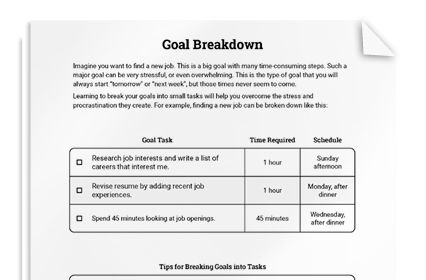
- Break large tasks into smaller pieces. It’s easy to feel overwhelmed when you have a really big task before you. Breaking big tasks into small pieces will help you get started, which is often the hardest part. For example, writing a paper can be reduced to pieces such as doing research, preparing an outline, and writing an introductory paragraph.
- Limit distractions. Spend a few days recording how much time you spend on distractions such as social media or TV. Then, cut out the distractions you don’t actually enjoy, and schedule time for the ones you do enjoy. Always set an alarm so you know when to get back to work.
- If you can’t limit your distractions, get away from them. If you know that you will succumb to distractions, get away from them. Create clear boundaries between work and play by putting up a “Do Not Disturb” sign on your door, turning off your phone, or going to a coffee shop without a TV. Everyone is different in this regard— make the changes you need to focus.
- Give yourself time between tasks. Plan on arriving to appointments 15 minutes early, and bring something to do in case you find yourself waiting. Scheduling some buffer time will help to reduce your stress when things inevitably run long.
- Let yourself be less than perfect. If you try to complete every task to perfection, some of your other responsibilities won’t get done at all. Focus on completing everything to an acceptable level, and then go back to improve upon your work if you have time.
Legal and Ethical Resources
- APA Telepsychology Resources - Database of telepsychology articles, continuing education, and more.
- Licensure Related Matters and COVID-19 - Database of information about local licensure boards’ COVID-19 related changes.
- Practicing Distance Therapy, Legally and Ethically - Brief article by the APA about ethical and legal guidelines for online therapy.
- The COVID-19 Telehealth Waiver - Summary of laws and regulations that are being loosened during COVID-19 for Medicare patients.
Tips for Parents: Managing ADHD
- Establish a predictable daily routine.
- Set clear and realistic rules.
- Use rewards and punishments consistently.
- Ensure that your child is eating a healthy diet.
- Ensure at least 8 hours of sleep each night.
Categories of PTSD Symptoms
- Hyper-Arousal: An unpleasant sensation where the person feels hyper-aware of every stimuli. Aware of every tiny sound, the person is hyper-vigilant, startles easily, and often feels irritable and angry. It is difficult to concentrate. Hyper-arousal symptoms are a crescendo from mild anxiety all the way up to a full-fledged fight or flight reaction, or a panic attack that sends someone to the emergency room.
- Intrusive Recollection: Unpleasant thoughts related to the trauma. Sometimes there are nightmares or recurring bad dreams. Flashbacks are a serious form of intrusive thoughts that make a person feel as if they are right back in the middle of the trauma once again.
- Avoidance / Numbing: The person avoids situations, thoughts, and feelings that remind them of the trauma. This can make a person's world much smaller as they work to avoid all traumatic cues. A great deal of energy is used trying not to think about it. Emotional affect is flattened. There may be a sense that the future is fore-shortened.
- What experiences is this thought based on?
- What are the facts that support your thought?
- What is the strongest evidence to support this thought?
- Is this thought based on something someone said to you?
- How long have you believed this?
- How strongly do you believe this thought is true?
Exploration Questions
- Get enough sleep. Forgoing sleep in order to study is actually associated with doing more poorly on the test (8).
- Avoid caffeine. It might be tempting to consume a lot of caffeine in order to feel alert, but caffeine can exacerbate anxiety (4).
- Arrive right on time. By doing this, you avoid anxiety-inducing situations, such as seeing others cramming for the test, discussing what will be on the test, and hearing others voice their own anxieties (5).
- Get comfortable. Eat a good meal before the test, wear comfortable clothes, and choose your favorite seat in the classroom (5).
Come Prepared
 |
What are 5 things you can see? Look for small details such as a pattern on the ceiling, the way light reflects off a surface, or an object you never noticed. |
 |
What are 4 things you can feel? Notice the sensation of clothing on your body, the sun on your skin, or the feeling of the chair you are sitting in. Pick up an object and examine its weight, texture, and other physical qualities. |
 |
What are 3 things you can hear? Pay special attention to the sounds your mind has tuned out, such as a ticking clock, distant traffic, or trees blowing in the wind. |
 |
What are 2 things you can smell? Try to notice smells in the air around you, like an air freshener or freshly mowed grass. You may also look around for something that has a scent, such as a flower or an unlit candle. |
 |
What is 1 thing you can taste? Carry gum, candy, or small snacks for this step. Pop one in your mouth and focus your attention closely on the flavors. |
- Name all the objects you see.
- Describe the steps in performing an activity you know how to do well. For example, how to shoot a basketball, prepare your favorite meal, or tie a knot.
- Count backwards from 100 by 7.
- Pick up an object and describe it in detail. Describe its color, texture, size, weight, scent, and any other qualities you notice.
- Spell your full name, and the names of three other people, backwards.
- Name all your family members, their ages, and one of their favorite activities.
- Read something backwards, letter-by-letter. Practice for at least a few minutes.
- Think of an object and “draw” it in your mind, or in the air with your finger. Try drawing your home, a vehicle, or an animal.
- DARE Programs: Children are taught by uniformed police officers about the dangers of drugs. Studies indicate that these programs are completely ineffective and may even increase experimentation with alcohol and other drugs.
- "Scared Straight" Programs: At-risk youths are exposed to prisons in an attempt to scare them away from committing crimes. Participants in these programs are more likely to offend in the future.
- Boot Camps for Conduct Disorder: Adolescents are taught to respect authority in military-style boot camps. Boot camps have been found to have no significant effect on behavior.
- Relaxation for Panic-Prone Clients: Because of a heightened focus on bodily sensations, some panic-prone clients can experience panic attacks as a result of relaxation techniques.
Important ordered lists
- Sit back in a comfortable position. You can close your eyes, but it isn’t necessary. TIP: When learning to use deep breathing, try placing one hand on your abdomen so you can feel it rise and fall with each breath. This will get you in the habit of taking large breaths, filling your lungs.
- Breathe in slowly through your nose. Time the inhalation to last 4 seconds. It's fine to go even slower, if you prefer.
- Hold the air within your lungs, but not to the point of strain. 4 seconds is a good target to aim for.
- Pucker your lips, and slowly exhale through your mouth. Time the exhalation to last 6 seconds. TIP: For practice, try exhaling through a straw. This will get you in the habit of exhaling slowly.
- Repeat the breathing cycle for at least 2 minutes. Practice for 5 to 10 minutes for greater benefits.
How to Use Deep Breathing
- Take 5 long, deep breaths through your nose, and exhale through puckered lips.
- Place both feet flat on the floor. Wiggle your toes. Curl and uncurl your toes several times. Spend a moment noticing the sensations in your feet.
- Stomp your feet on the ground several times. Pay attention to the sensations in your feet and legs as you make contact with the ground.
- Clench your hands into fists, then release the tension. Repeat this 10 times.
- Press your palms together. Press them harder and hold this pose for 15 seconds. Pay attention to the feeling of tension in your hands and arms.
- Rub your palms together briskly. Notice the sound and the feeling of warmth.
- Reach your hands over your head like you’re trying to reach the sky. Stretch like this for 5 seconds. Bring your arms down and let them relax at your sides.
- Take 5 more deep breaths and notice the feeling of calm in your body.
Very important ordered lists
Before you begin, ask yourself why you feel upset.
Are you angry because your partner left the mustard on the counter? Or are you angry because you feel like you’re doing an uneven share of the housework, and this is just one more piece of evidence? Take time to think about your own feelings before starting an argument.
Discuss one topic at a time.
Don’t let “You left dishes in the sink” turn into “You watch too much TV.” Discussions that get off-topic are more likely to get heated, and less likely to solve the original problem. Choose one topic and stick to it.
No degrading language.
Discuss the issue, not the person. No put-downs, swearing, or name-calling. Degrading language is an attempt to express negative feelings while making sure your partner feels just as bad. Doing so leads to more character attacks while the original issue is forgotten.
Express your feelings with words.
“I feel hurt when you ignore my phone calls.” “I feel scared when you yell.” Structure your sentences as “I” statements (“I feel emotion when event”) to express how you feel while taking responsibility for your emotions. However, starting with “I” does not give a license to ignore the other fair fighting rules.
Take turns speaking.
Give your full attention while your partner speaks. Avoid making corrections or thinking about what you want to say. Your only job is to understand their point of view, even if you disagree. If you find it difficult to not interrupt, try setting a timer allowing 1-2 minutes for each person to speak without interruption.
No stonewalling.
Sometimes, the easiest way to respond to an argument is to retreat into your shell and refuse to speak. This is called stonewalling. You might feel better temporarily, but the original issue will remain unresolved and your partner will feel more upset. If you absolutely cannot go on, tell your partner you need to take a time-out. Agree to resume the discussion later.
No yelling.
Yelling does not help anyone see your point of view. Instead, it sends the message that only your words matter. Even if yelling intimidates your partner into giving up, the underlying problem only grows worse.
Take a time-out if things get too heated.
In a perfect world, we would all follow these rules 100% of the time... but it just doesn’t work like that. If an argument starts to become personal or heated, take a time-out. Agree on a time to come back and discuss the problem after everyone has cooled down.
Attempt to come to a compromise or an understanding.
There isn’t always a perfect answer to an argument. Life is too messy for that. Do your best to come to a compromise (this means some give and take from both sides). If you can’t come to a compromise, simply taking the time to understand your partner’s perspective can help soothe negative feelings.
Mini-cards
This version of the thought record is simple, clean, and professional. It offers plenty of space for your clients to record their thoughts, feelings, and behaviors.
If you want to learn more about using thought records effectively, check out our treatment guides on CBT psychoeducation and cognitive restructuring.
The process of identifying and changing these irrational thoughts is called cognitive restructuring. See our guide and worksheets on cognitive restructuring to learn specific techniques:
Mini-cards containers
More Trauma Resources
Relaxation Techniques
Check out our resources for coping during this time of uncertainty:
Positive journaling can foster optimism, which contributes to stress resilience. Positive journaling involves writing about daily positive experiences. It tends to be easy to remember negative experiences, but it takes more work to recall and appreciate positive experiences. Positive journaling is a great way to appreciate these experiences. For a journal template, try the positive journal packet:
Showing gratitude can increase self-esteem, which contributes to resilience. There are a number of ways to show gratitude, including gratitude journaling, telling someone “thank you”, and visiting someone you appreciate. Check out the following gratitude resources:
Pull quotes
Our interconnectedness with those who came before us is the key focus of Weller’s fifth and final gate—ancestral grief. This type of grief encompasses experiences of violence, genocide, racism, and other traumas our ancestors endured. According to Weller (2015), we carry the burden of our forebearers’ tribulations. For disadvantaged groups, COVID was a painful reminder of long-standing societal inequalities, such as lacking health care access among immigrants, indigenous peoples, and communities of color.
The isolation and societal division brought into stark relief by COVID reflect the loneliness of living outside of community. “In a very real way,” writes Weller (2015), “we have lost our connection to the land, language, imagination, rituals, songs, and stories of our ancestors.”
But it is this realization that can motivate us to build deeper communal bonds and address social injustices. One thing is for sure: We cannot meet the challenges of the contemporary world as isolated individuals. Only community can save us.
Grieving and Healing Together
Expressing grief in community is crucial to healing the many losses described in this article. When shared with others, grief can tear down our defenses and open our hearts. Ritual is a powerful means of working with our pain in a way that connects us to others. Mourning with others “offers us the means of tending wounds and sorrows, for offering gratitude, and for reconciling conflicts” (Weller, 2015).
Communal grief rituals come in many forms. Reminiscing with others about those we have lost is a ritual. Praying or meditating with others around a common point of focus is another variation. Even psychotherapy is a kind of ritual in which suffering is shared, explored, and healed in the presence of another person.
Regardless of the type of ritual, the crucial element is that two or more people join together to pay tribute to their losses through a collective act, such as sharing stories or observing silence. In the sacred space of ritual, our private grief becomes part of a communal experience that eases our burden and cements our belonging with others.
Tips
Tip: Share a list of common cognitive distortions with your clients to start a discussion about how our thoughts impact emotions, whether or not they’re accurate. Most clients will identify with at least a few of the cognitive distortions, and easily connect them with their own experiences. In a group, ask participants to circle the cognitive distortions they’ve fallen victim to, and share stories. Tip: If you are distracted by your self-portrait in the corner of the screen, feel free to cover it! Tip: When emotions seem to sneak up on your client, or if they have a hard time identifying their emotions, have a discussion about warning signs. How do they feel or behave differently immediately before the situation occurs? For example, someone struggling with anger might notice that their face feels hot, or their voice trembles, before they “snap”.Ask clients to keep a log of their behaviors when their anxiety is highest. This often reveals their avoidant pattern.
Challenge clients to imagine their lives without anxiety. What would they be doing that they are not doing now?
Have clients list their top-three values and then explore what keeps them from living according to those values.
Effective exposure therapy requires eliminating so-called “safety behaviors.” These include distraction and reassurance-seeking, among others.
Use our Exposure Tracking Log to monitor these behaviors throughout treatment. Be sure to check for mental rituals, such as counting or repeating a word or phrase.
Examples
Example: "During your first sessions, it was terrifying for you to talk about your trauma. When you tried, your body shook, and you would try to change the subject. Now you’re able to tell the story almost matter-of-factly, without a single tear. Even though you still have painful feelings about the situation, and you still have some difficult moments, you have come a long way." Example: Someone who is just starting to feel angry might act defensively and argumentative. As they become more angry, they become aggressive by raising their voice and using insults. Here’s how these symptoms are recorded: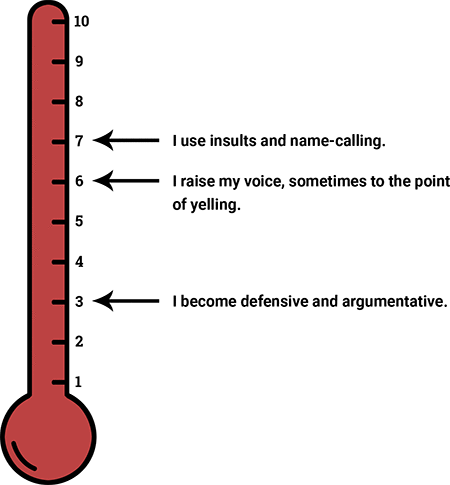
Example: Emily is a stay-at-home mother. Prior to becoming a mother, she pursued a demanding career as a marine biologist. Due to this major life change, some of the strengths she used to utilize, such as ambition and curiosity, have become underutilized.
In a strengths-based intervention, Emily and her therapist create a plan that will enable her to continue using her strengths in her role as a mother. Emily decides to begin teaching her daughter about science once a week through fun activities. Additionally, Emily starts to work a few hours a week from home as an editor for colleagues’ research papers.
Chat Bubble
“I’ll never get through this.”
“I have to be perfect all the time.”
“If I don’t get an A on the test, I’m a total failure.”
Therapist: What troubles you most about using public restrooms?
Client: I’m afraid I might touch something that’s contaminated.
Therapist: Why would that be a problem?
Client: I could contract a contagious disease and get really sick.
Therapist: What would be the worst thing about that?
Client: I would miss work and maybe even die.
Therapist: Anything else?
Client: I could accidentally infect my daughter.
Therapist: What would that mean?
Client: That I'm a failure as a mother.
Client: I always worry that my date won’t like how I look, or I’ll make a fool of myself. This leads to me getting so nervous that I do make a fool of myself.
Therapist: So, what if those things come true? What if your date doesn’t like how you look, or you make a fool of yourself?
Client: Well, we probably won’t have a second date…
Therapist: What if you don’t have a second date? What happens then?
Client: I guess nothing. I just won’t see them again.
Tables
Acute Symptoms symptoms that occur before or during a stressful situation |
||
|---|---|---|
| Physical | Emotional / Cognitive | Behavioral |
|
|
|
| Movies | Countires | Books |
| Cereals | Sports Teams | Colors |
| Cars | Fruits & Vegetables | Animals |
| Cities | TV Shows | Famous People |
| Example: Thought Record | ||||
|---|---|---|---|---|
| Situation | Thoughts | Emotions | Behaviors | Alternate Thought |
| Everyone’s busy, so I’m spending an evening alone with no plans. | No one wants to hang out with me. I’m just wasting my life, sitting here alone. | Depressed | Stayed home all night and did nothing. Just sat around having bad thoughts. | I’m alone tonight, but everyone is alone from time to time. I can do whatever I want! |
| A difficult assignment is due at school. | This is so much work. I’m horrible at this stuff. I don’t think I can do it. | Anxious | Avoided the assignment until the last minute. Had to rush my work. | This is a difficult assignment, and it’ll take a lot of work. But I know I can do it if I break it into small pieces. |
| Thought Record Instructions | ||
|---|---|---|
| Columns | Instructions | Example Entry |
| Situation | Describe the situation that led to unwanted emotions or behaviors. Record only the facts of what happened, without any interpretation. | I received negative feedback about a report I wrote at work. |
| Thoughts | Thoughts are like an inner monologue. They can be statements or questions. | I really messed this up. I don’t think I’m cut out for this job. Will they fire me? |
| Emotions | Write a single word or a description of a feeling. If your feelings changed throughout the experience, describe that process. | Felt bad about myself. Anxious. |
| Behaviors | Record what you did in response to the situation. | I procrastinated on fixing my work because it seemed so daunting. This made everything worse! |
| Alternate Thought | What’s a different thought you could’ve had? The goal isn’t to be overly positive—you just want to be fair. | I made a mistake on my work, but it isn’t that big of a deal. I’ll correct it, and no one will care in a few days. |
| Example: Putting Thoughts on Trial | |
|---|---|
| The Thought My partner probably hates me. (after an argument about housework) |
|
| The Defense argument in defense of the thought |
The Prosecution argument against the thought |
|
|
| The Verdict Arguments are sometimes upsetting, but overall, this is a healthy and loving relationship. There’s no evidence that my partner hates me. |
|
| Maladaptive Thought | New Thought |
|---|---|
| “I’m a bad mom.” | “Like any mother, I’ve made mistakes... but I love and support my kids as best I can.” |
| “I’ll never make it as a teacher.” | “I’m still new and have a lot to learn as a teacher. But I’ve done other difficult things, and I can do this too.” |
| “People don’t like spending time with me because I’m awkward.” | “I feel way more awkward than I actually am. I might not be the most popular, but I have several good friends.” |
Element Attributions
- Being drawn to things that allow for use of the strength.
- Desiring to use the strength and feeling drained if not using it.
- Prioritizing tasks that require use of the strength.
- Desire to learn new information related to the strength.
- Sense of energy and engagement when using the strength.
- Having success when using the strength.
Signs of Strengths
|
Chronic Symptoms
symptoms and consequences of long-term stress |
||
|---|---|---|
|
|
|
Random White Boxes
Note: The mental health community has not settled on a definitive winner when it comes to terminology. You might hear “telehealth”, “teletherapy”, “internet-based counseling”, and many other variations of these. In this article, we will use the terms “online therapy” and “in-person therapy”. Note: Complete any necessary consent forms not only for your primary online therapy tool, but also for your backups.Therapist: I just noticed a sudden change in your demeanor. A moment ago, you had a big smile on your face. But then, when I asked about school, your face clouded over, and you looked really upset. What thought was going through your mind in that moment?
Therapist: We’ve talked about how your depression leads to thoughts such as “I’m worthless,” and “I’ll never make it as a teacher.” What thought would you say is most distressing for you?
Imagery Education Script
Mental images are the pictures you see in your mind. Nearly everyone experiences some type of images. These images can also include any of the five senses. For example, you can "hear" sounds in your imagination. You might also smell, taste, or feel things in your imagination. Images may be clear or unclear, fleeting or long-lasting. When I refer to "mental images", this is what I’m referring to.
------
Developing treatment goals at the start of therapy can improve client retention, set a direction for future sessions, and help your clients begin to envision their desired outcomes. We've created the Therapy Goals worksheet to help your clients think about, and verbalize, their hopes for therapy.
The Therapy Goals worksheet opens with broader questions, including a variation of the popular "magic wand" question. The magic wand question asks clients to imagine that they wake up, and all of their problems are solved. It goes on to ask how they would notice the change. What exactly is different? This question encourages responses with specific examples about how your clients would like to change their lives.
The second page of this worksheet becomes more treatment-oriented, and asks questions about your clients' goals for therapy. This section is valuable for treatment planning, and creating an outline for upcoming therapy sessions.